


The websites of the five active political parties contain virtually no information about their budgets, performance, or membership requirements—despite the “principle of transparency” and the obligation to publish reports for the public.
We examine how the state and party members financially support the party system—which, in turn, provides access to power.
Text: Diyora Akhmedova
Editor: Vera Karpova
There are five parties in Uzbekistan—almost all of them were registered 20 years ago
There are five parties in Uzbekistan—almost all of them were registered 20 years ago
The only exception is the Ecological party founded in 2019 on the basis of the Ecological Movement of Uzbekistan, which already had representation in parliament at that time. By comparison, neighboring Kazakhstan and Tajikistan each have seven active parties, while Kyrgyzstan has more than 300.
During the parliamentary elections held in October 2024, international observers noted the absence of genuine competition, and representatives of the European External Action Service concluded that voters “had no real choice”.
What do the political parties offer citizens in their programs?
The Liberal Democratic Party (UzLiDeP). It positions itself as a “movement of entrepreneurs and businesspeople” and advocates for economic development, liberal-democratic values, parliamentary and public oversight, as well as “the intellectual potential of society.” As of the end of December 2024, the party had more than 1.5 million members.
The Social Democratic Party “Adolat.” It promotes the ideas of social justice and equality, the protection of human rights, and the development of civil society. In December 2024, the party had more than 1 million members.
The “Milliy Tiklanish” Democratic Party. It advocates for the protection of national identity and traditions under the slogan “From National Revival to National Resurgence,” and also supports the development of science and education. As of December 2024, the party had more than 760,000 members.
People’s Democratic Party of Uzbekistan. It advocates for social justice and equality, support for vulnerable segments of the population, and the promotion of their economic and social interests. As of the end of December 2024, the party had more than 700,000 members.
The Ecological Party of Uzbekistan. It is the only new party registered in the last twenty years. The Ecological Party was founded on the basis of the Ecological Movement of Uzbekistan, which already had about 250,000 members at the time of the party’s creation in 2019.
The party promotes the ideas of sustainable development, combating environmental problems, and addressing climate change. As of December 2024, the party had more than 630,000 members.
We don’t know how much money the political parties have or what they spend it on
We don’t know how much money the political parties have or what they spend it on
Political parties are funded through the state budget, membership dues, merchandise sales, and donations. The law on the financing of political parties stipulates that budget information must be made available to the public, including the sources of funding and the amount of funding.
We were unable to find any information on funding or expenditures on any of the parties’ websites.
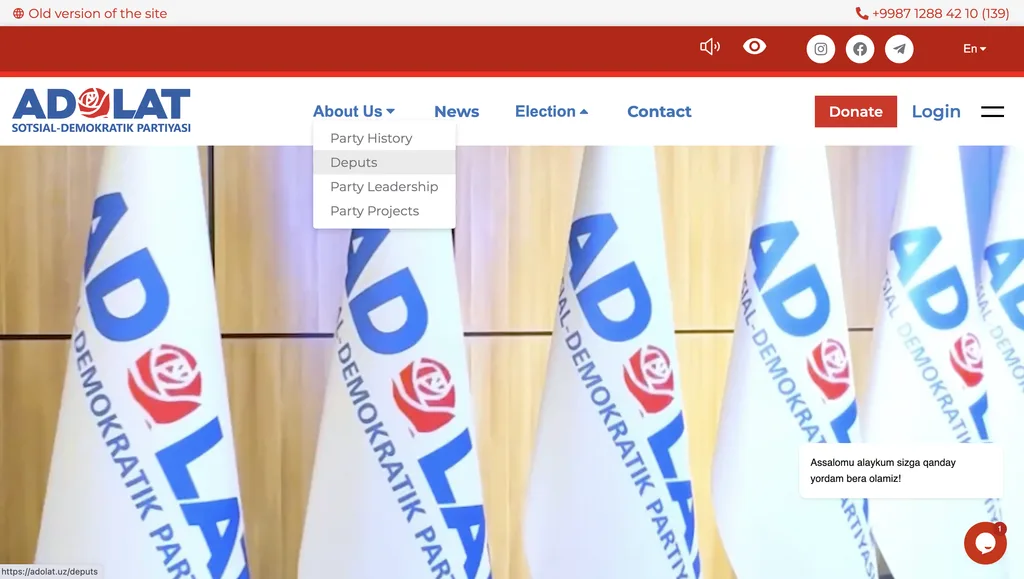
That said, it’s not that the websites are poorly designed, making it difficult to access the financial reports. On each of them, you can make an online donation via payment apps or buy merchandise from the online store—they’re quite modern—but there’s simply no section or page dedicated to publishing financial reports.
However, some data can still be found in the public domain or calculated manually.
How much money do political parties receive from membership dues?
How much money do political parties receive from membership dues?
Political parties receive monthly membership dues. These are paid by every party member, except for retirees and students. The law does not specify a particular amount for membership dues, and parties must set their own rates. Since party websites do not provide information about finances, we attempted to calculate the amounts ourselves.
Back in 2025, UzLiDeP stated during a phone inquiry that the membership fee was 1% of the minimum wage—in 2026, that amounts to 13,600 sum from all members, except for retirees and students. This party has at least 1.5 million members.
If we assume that at least one-third of them pay dues, the UzLiDeP party receives more than 6.8 billion soums, or $575,000, per month.
The Ecological Party currently has 670,000 members, while, for example, “Adolat” has more than one million. In total, political parties have about 4 million members—or nearly one in six adult residents of Uzbekistan. Most likely, all of them are civil servants or employees of government-funded organizations.
This means that several million dollars circulate monthly through the membership dues system alone.
And how much money do political parties receive from the budget?
And how much money do political parties receive from the budget?
The average citizen cannot find the parties’ budgets on their websites—even though they are funded not only by membership dues but also directly from taxpayer money.
The state allocates funds annually for the parties’ statutory activities. In July 2024, these subsidies were increased. Shortly before the parliamentary elections, the president signed amendments to the Law “On the Financing of Political Parties.”
Now, 2.5% of the Base Calculation Value, multiplied by the number of citizens on the voter rolls during the last election to the Legislative Chamber, is allocated to all five parties. We checked—in 2024, there were about 20 million such people.
This means that in 2026, political parties will receive more than 220 billion soums, or $18.6 million, from the state alone.
Of this money, 60% is distributed proportionally based on the number of deputies each party holds in parliament. UzLiDeP will receive the largest share, as this party holds significantly more seats in parliament.

40% of this amount is divided equally among the five parties—that works out to 17 billion soums, or $1.5 million per party per year.
This is a small amount when compared to the expenditures of large public organizations operating at the national level. But it is quite significant, given the apolitical nature of most of the population, the lack of genuine pluralism of opinion in parliament, and the complete lack of transparency regarding expenditures—which the law requires political parties to provide.
What Else Makes Up the Party Economy?
What Else Makes Up the Party Economy?
The most comprehensive overview of the party’s activities can be found on the UzLiDeP website. The “Projects” section contains information on 10 initiatives, and the news section regularly publishes reports on upcoming or past meetings and roundtables. No budget information is provided.
On the websites of other parties, news items also mainly cover meetings with party members and voters. However, the most recent information about the Adolat party’s projects dates back to 2024.
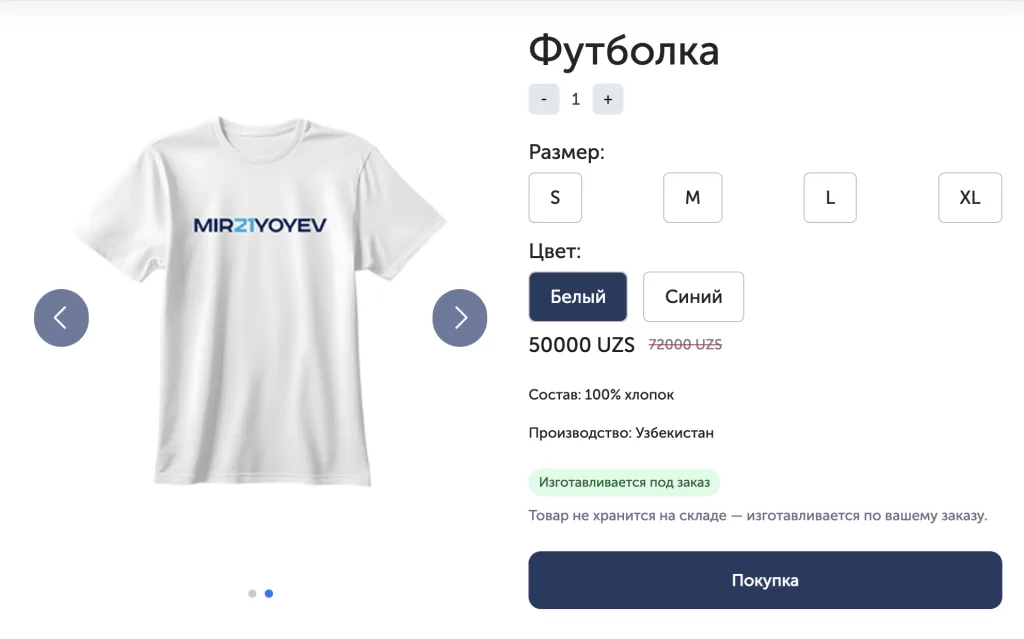
Visitors to all the parties’ websites can also make donations, and four of them feature online stores selling merchandise. A significant portion of the merchandise on the UzLiDeP website is dedicated specifically to the president—T-shirts bearing the name “Mirziyoyev” were designed for the 2021 election and are still being made to order.
Political parties are required by the “Law on the Financing of Political Parties” to disclose their budgets. Article 5 of the law states that “parties shall ensure that information about their financing is accessible to their members and the public,” and that they must “publish information on the amount and sources of funding for their activities.”
Article 17 of the law further states that parties “shall publish their budgets annually for public information.” A review of the websites of five parties makes it clear that they are not complying with this regulatory requirement—or do not consider their websites to be a suitable platform for publications intended for public information.
Political parties retain a monopoly on power—only by joining them can one gain real political influence
Political parties retain a monopoly on power—only by joining them can one gain real political influence
Only party members may run for parliament or for president. This rule has been in effect in Uzbekistan since 2009—previously, independent candidates were also allowed to participate in elections. Human rights organizations have argued that this restriction violates human rights.
Since 2009, only party members in Uzbekistan have been eligible to run for parliament or the presidency.
Party members can form their own parliamentary factions—groups of lawmakers who belong to specific parties and collectively represent their interests. Factions have more influence than individual lawmakers.
For example, the passage of bills and strategic decisions depends on these factions; they can participate in setting the agenda for the sessions of the Legislative Chamber. They can also directly address the president, the government, and other high-ranking officials on specific issues.
What is the situation with opposition parties in Uzbekistan?
What is the situation with opposition parties in Uzbekistan?
There is an extra-systemic opposition in the country—these are groups that are unable to obtain official registration and, as a result, cannot participate in the country’s political life on an equal footing with registered parties.
One such initiative is the unregistered opposition party “Truth and Progress,” founded by economist Khidirnazar Allakulov.
The founding convention was postponed several times, but in 2021, activists finally managed to organize a meeting at which they adopted a charter and announced that they had collected more than 32,000 signatures. However, the Ministry of Justice deemed most of them invalid and denied registration. In 2023, Allakulov was denied party registration for the third time.
There have been attempts in the country to foster a systematic opposition. In May 2025, the People’s Democratic Party of Uzbekistan declared itself the “parliamentary opposition,” and exactly three months later, the president expanded the rights of opposition factions and parties. Despite this, no significant differences in position between the organized opposition and the majority have come to light over the past year.
A truly opposition party has been registered only once in the entire history of independent Uzbekistan. In 1991, the Ministry of Justice registered the democratic party “Erk,” but just three years later, the party was denied a renewal of its registration—and it was not possible to reinstate it even after the change in government.
It’s difficult to get in touch with political parties, and it’s unclear what rules apply to members
It’s difficult to get in touch with political parties, and it’s unclear what rules apply to members
Although almost every website offers the option to apply for membership online, it’s practically impossible to find information about membership requirements in advance. There are also addresses for offices where you can apply in person.
While working on previous reports, Sarpa sent letters and spent a long time trying to reach the phone numbers listed on all the parties’ websites to learn more about membership requirements. As a result, we received no replies by mail and only two responses to our calls—from UzLiDeP and “Milliy Tiklanish.” We still weren’t able to get clear answers to our questions—we were passed around, asked to call back, and told they wouldn’t send us any documents.
Please share your experiences with joining a political party in the comments on Instagram or by emailing sarpatas@protonmail.com. We’ll keep trying to figure out how this system works.